
Thank you very much for voting my blog!!. As you can see I'm working on it, in order to do a better one. See you soon!!
miércoles, 18 de marzo de 2009

It’s a fact that the English have been showing off the power of their navy (known as Royal Navy) and their won battles during all the history, overall against the French, and logically, us, the Spanish. You probably have heard something about the Battle of Trafalgar, where the English gave us a great hiding (the truth is that we were very bad commanded by the admiral Villeneuve) , the conquest of Gibraltar, or the most well-known(I’m sure you know it too): The Disaster of the “Invincible Navy” (Armada Invencible).
But I’m sure you don’t know that we gave a great great (yes, two times great ) beating to the English (logically in the sea, because if it’s in land, there isn’t nothing to say… xD). It was the “Battle of Cartagena de Indias” and I think that English won’t never forget this battle… Would you like to know more? Pay attention and you will be wondered…
It was in 1741, concretely in March. The English were going to Cartagena de Indias, with a very big fleet (the biggest until the fleet used in the D-Day), comprised of 186 ships, 23.600 English and Jamaicans soldiers, and 4000 recruits of Virgina. The man who had to defend us was Blas de Lezo y Olavarrieta (most known as Blas de Lezo). He born in Pasajes (Guipúzcoa), in 1689. At the age of 12 he was enlisted in the Navy as midshipman (guardiamarina in Spanish). With 15 years, his right arm was amputated (without anesthesia). Four years later, a splinter of grapeshot ruined his left eye, and it isn’t all, because at the age of 23 he lost the left leg… He was known as “middleman” and also “patapalo”.
But these things weren’t a obstacle to defeat the English. He only disposed of 3000 soldiers, 600 Indian archers and ships. How this man could defeat the English? He was a privileged mind, a great strategist. See the following videos and you will understand:
Video about the life of Blas de Lezo
Video about the battle.
Incredible, don’t you think?. But it isn’t the last thing; I’m going to tell you an anecdote:
Admiral Vernon wrote a letter to Lezo, saying him “We leave Cartagena because we are going to go to Jamaica in order to get reinforcements, don’t think you will win…”
Blas de Lezo answered his letter, telling him: “OK, leave Cartagena, but please, go directly to England and ask for your King to build a new fleet, because with this one, you only can carry carbon between London and Dublin…”
The King George II ordered to his historians to hide the history, because they suffered a great humiliation. This is the main reason because of we don’t know anything about Blas de Lezo and other Spanish heros (mmmhh the English will probably know who was Álvaro de Bazán, but he will be in other post). Now you know what to answer to the English when they say you “…Yes, but we won all our battles in the Sea against you…” (hahaha it’s a joke isn't it? )
I hope you liked it. See you soon!
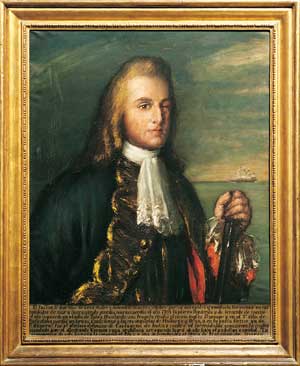
Blas de Lezo

Blas de Lezo's Coat of Arms
But I’m sure you don’t know that we gave a great great (yes, two times great ) beating to the English (logically in the sea, because if it’s in land, there isn’t nothing to say… xD). It was the “Battle of Cartagena de Indias” and I think that English won’t never forget this battle… Would you like to know more? Pay attention and you will be wondered…
It was in 1741, concretely in March. The English were going to Cartagena de Indias, with a very big fleet (the biggest until the fleet used in the D-Day), comprised of 186 ships, 23.600 English and Jamaicans soldiers, and 4000 recruits of Virgina. The man who had to defend us was Blas de Lezo y Olavarrieta (most known as Blas de Lezo). He born in Pasajes (Guipúzcoa), in 1689. At the age of 12 he was enlisted in the Navy as midshipman (guardiamarina in Spanish). With 15 years, his right arm was amputated (without anesthesia). Four years later, a splinter of grapeshot ruined his left eye, and it isn’t all, because at the age of 23 he lost the left leg… He was known as “middleman” and also “patapalo”.
But these things weren’t a obstacle to defeat the English. He only disposed of 3000 soldiers, 600 Indian archers and ships. How this man could defeat the English? He was a privileged mind, a great strategist. See the following videos and you will understand:
Video about the life of Blas de Lezo
Video about the battle.
Incredible, don’t you think?. But it isn’t the last thing; I’m going to tell you an anecdote:
Admiral Vernon wrote a letter to Lezo, saying him “We leave Cartagena because we are going to go to Jamaica in order to get reinforcements, don’t think you will win…”
Blas de Lezo answered his letter, telling him: “OK, leave Cartagena, but please, go directly to England and ask for your King to build a new fleet, because with this one, you only can carry carbon between London and Dublin…”
The King George II ordered to his historians to hide the history, because they suffered a great humiliation. This is the main reason because of we don’t know anything about Blas de Lezo and other Spanish heros (mmmhh the English will probably know who was Álvaro de Bazán, but he will be in other post). Now you know what to answer to the English when they say you “…Yes, but we won all our battles in the Sea against you…” (hahaha it’s a joke isn't it? )
I hope you liked it. See you soon!
Blas de Lezo
Blas de Lezo's Coat of Arms
miércoles, 11 de marzo de 2009
The first post had to be about Ceuta, the city where I've been living during 12 years (most part of my life). Although I was born here (and my family is from here), I moved there one month after my 4th birthday. Whereas people say that Ceuta (What is it?,no?) is a poor city, because it's in the north of Africa, I must say (as a ceuti) that it isn't true: Ceuta is a modern city (I haven't still seen some things of Ceuta in Extremadura) which have a very interesting bussiness projection, due to its magnific port (one of the most important of the Mediterranean Sea, because it's in a strategic geographical situation).
Furthermore, Ceuta can say it's the only city in Spain that decided to be spanish. The reason was the following: In 1640, as we known, there were independestist revolutions in Cataluña and Portugal (in that age Portugal was a part of the Spanish Kingdom). The king's assistors centred the power of the army in Cataluña, and left Portugal. Then the last one got its independence, and Ceuta was asked about the country it would like to be part of (because Ceuta was originally conquered by the Portuguese, in 1415,leading the army the King Don João I, John I), by referendum. The city finally decided to stay with Spain.
But the history of this city is bigger than you can think (they were there fenicians,greeks,romans, arabs...), it's has sufferred great sieges of different Kingdoms (one of the hardest was against an English-Dutch fleet ), there are legends telling that in its small nearly islands were hidden treasures of pirates, or bases of them (El "Desnarigado" is one of the most know, he was a pirate whose nose was cutted as punishment by his crimes)
I could be writing for hours but I never would arrive to the end (because Ceuta has a lot of things to tell), so I recommend to all people who read this post to visit Ceuta; I'm sure you will like it very much.
As a curiosity, you can see that the flag of ceuta is the same that the Lisbon's flag, and its coat of arms is nearly identical to the portuguese one in the flag of this country.
Links about Ceuta:
* http://en.wikipedia.org/wiki/Ceuta (not very well, because there aren't only nine schools in Ceuta, as the article say, between other things)
* http://es.wikipedia.org/wiki/Ceuta (in spanish, but much better)
* http://www.conoceceuta.com/ (Page for tourists)
* http://www.ceuta.es/ (The official page)

Plaza de África after the visiting of the spanish Kings

The Dragons's building

Regulares 54th Headquarter

Real Walls at night (note the Portuguese
architecture)
Furthermore, Ceuta can say it's the only city in Spain that decided to be spanish. The reason was the following: In 1640, as we known, there were independestist revolutions in Cataluña and Portugal (in that age Portugal was a part of the Spanish Kingdom). The king's assistors centred the power of the army in Cataluña, and left Portugal. Then the last one got its independence, and Ceuta was asked about the country it would like to be part of (because Ceuta was originally conquered by the Portuguese, in 1415,leading the army the King Don João I, John I), by referendum. The city finally decided to stay with Spain.
But the history of this city is bigger than you can think (they were there fenicians,greeks,romans, arabs...), it's has sufferred great sieges of different Kingdoms (one of the hardest was against an English-Dutch fleet ), there are legends telling that in its small nearly islands were hidden treasures of pirates, or bases of them (El "Desnarigado" is one of the most know, he was a pirate whose nose was cutted as punishment by his crimes)
I could be writing for hours but I never would arrive to the end (because Ceuta has a lot of things to tell), so I recommend to all people who read this post to visit Ceuta; I'm sure you will like it very much.
As a curiosity, you can see that the flag of ceuta is the same that the Lisbon's flag, and its coat of arms is nearly identical to the portuguese one in the flag of this country.
Links about Ceuta:
* http://en.wikipedia.org/wiki/Ceuta (not very well, because there aren't only nine schools in Ceuta, as the article say, between other things)
* http://es.wikipedia.org/wiki/Ceuta (in spanish, but much better)
* http://www.conoceceuta.com/ (Page for tourists)
* http://www.ceuta.es/ (The official page)
Plaza de África after the visiting of the spanish Kings
The Dragons's building
Regulares 54th Headquarter
Real Walls at night (note the Portuguese
architecture)
martes, 3 de marzo de 2009
Suscribirse a:
Entradas (Atom)